
AI week: safety gates, sovereign models, and agent identities
A founder-focused scan of the past seven days in AI: OpenAI's deployment-simulation safety method, Anthropic's model-access shock, Google's device-native AI features, Sarvam's sovereign-AI round, and new compliance/evaluator signals from Europe.

研究速览
Coverage window: June 11, 7:00 a.m. to June 18, 7:00 a.m. Pacific.
The signal this week is not one model leap. It is operational pressure: labs are trying to prove safer releases, enterprises are preparing for non-human workers, sovereign AI is attracting serious capital, and regulators are moving from principles into evaluator mechanics.
Monday scan
| Signal | What changed | Why founders and investors should care |
|---|---|---|
| Pre-release safety | OpenAI described Deployment Simulation, a method that replays de-identified prior conversations through candidate models before release; it analyzed about 1.3 million conversations across GPT-5 Thinking through GPT-5.4 deployments. 1 | Safety review is becoming an infra problem. Teams selling evals, audit tooling, synthetic users, red-team operations, or model-risk dashboards need to support production-like traffic, not only benchmark suites. |
| Access risk | Anthropic said a U.S. government export-control directive forced it to disable Fable 5 and Mythos 5 for all customers, while leaving other Anthropic models unaffected. 2 | Dependence on a single frontier provider now carries a policy and availability risk, not just price or latency risk. Multi-model routing and contractual fallbacks deserve board-level attention. |
| Consumer AI | Google's June Pixel Drop added Gemini Omni video editing, Gemini music generation, Screen reactions, broader Voice Translate support, Magic Cue for Snapchat, and regional expansion of Ask Photos editing. 3 | Consumer AI keeps moving into device-native creation and communication loops. Distribution through OS-level surfaces may matter more than standalone app installs for many creator tools. |
| Sovereign AI | Sarvam announced $234 million in funding at a $1.5 billion valuation, with HCLTech contributing $150 million as lead strategic investor. 4 | The sovereign AI thesis has an enterprise channel: model builder plus IT-services distribution plus government and regulated-sector demand. |
| Agent identity | NewCore emerged from stealth with $66 million in funding to manage human and AI-agent identities in one system. 5 | Agent deployment creates a permissioning market. Security budgets may shift from human-only identity toward lifecycle controls for software workers. |
| Verified AI | Pramaana Labs announced a $27 million seed round led by Khosla Ventures to apply formal verification to AI in sensitive domains such as law, drug discovery, and tax preparation. 6 | Reliability is becoming a product category, especially where an incorrect answer can create legal, financial, or medical exposure. |
| EU compliance | The European AI Office opened a June 21 expression-of-interest deadline for experts to join a July workshop on independence and qualification requirements for external evaluators of GPAI models with systemic risk. 7 | The compliance market is moving toward named roles, qualifications, and evaluator standards. That creates demand for audit-ready evidence trails. |

Product and model releases: user surfaces are eating the launch cycle
Google's Pixel update is the clearest product launch this week because the AI features sit directly inside device behavior: screen recording, video editing, music creation, call translation, call screening, and photo editing. 3 For founders building AI creation apps, that raises a distribution question: will users open a new tool, or will they accept the one already attached to the camera roll, phone call, messaging app, or screen recorder?
The same release also shows how quickly generative features are being bundled with hardware and subscription tiers. Gemini Omni on Pixel requires a Google AI subscription, while several call and safety features vary by device, geography, and language. 3 That is a useful reminder for investors evaluating AI consumer startups: model quality is only one part of the moat. Platform placement, permissions, default workflows, and regional rollout rights may decide adoption.
OpenAI's Deployment Simulation announcement belongs in the model-release bucket even though it is a safety-method release, not a public model launch. OpenAI says the method regenerates prior conversation contexts with a candidate model and uses those simulated completions to estimate undesired behavior rates before release. 1 The company reported a median multiplicative error of 1.5x across GPT-5-series Thinking deployments and said simulated traffic helped surface calculator hacking before release. 1
For AI infrastructure companies, the commercial read is straightforward: evaluation is shifting from static challenge sets toward realistic deployment distributions. Tools that can sample real workflows safely, preserve privacy, simulate tool calls, and compare pre- and post-release behavior will be easier to sell than another leaderboard wrapper.
Capital flows: investors are buying control layers
This week's funding rounds cluster around three kinds of control: national control, enterprise identity control, and correctness control.

Sarvam is the largest round in this scan. Its $234 million raise values the Bengaluru company at $1.5 billion; TechCrunch reported that Sarvam's conversational AI platform handles more than 2 million interactions per day and its inference platform processes roughly 10 million API calls daily. 4 The company is positioning itself across model development, inference infrastructure, and applications for Indian languages and regulated sectors. 4
NewCore's $66 million seed round is smaller but points to an urgent enterprise problem: agents need identity, permissions, revocation, and oversight. TechCrunch reported that NewCore wants to treat AI agents as first-class identities rather than service accounts, with integrations for Claude Code, OpenAI Codex, and Cursor. 5 If agents start initiating work across SaaS tools, identity vendors will have to answer a hard question: who authorized the action, a human, a software agent, or a chain of both?
Pramaana Labs is attacking reliability from a different angle. The company says it will combine LLMs with deterministic formal-verification layers, using LEAN-style systems and domain experts for areas such as tax law, cybersecurity, and drug discovery. 6 That is not a generic hallucination pitch. It is a bet that high-value AI deployments will need domain-specific proof systems, even if those systems take longer to build.
Policy and compliance: evaluator markets are forming
The most immediate compliance item is the European AI Office's call for experts. The office is seeking input on independence and qualification requirements for external evaluators of general-purpose AI models with systemic risk; expressions of interest are due June 21, and invitations are expected by July 7. 7 The workshop is meant to inform requirements under the GPAI Code of Practice and the AI Act framework. 7
That matters beyond Europe. Once evaluator qualifications, independence rules, and evidence standards become more concrete in one major market, enterprise buyers elsewhere will borrow the language for procurement. Founders selling model-risk tooling should map their product claims to evaluator workflows: evidence capture, reproducible test runs, risk taxonomy coverage, independence controls, and audit exports.
Anthropic's Fable 5 and Mythos 5 statement is the other compliance shock. Anthropic said it received a directive at 5:21 p.m. Eastern on June 12 and must disable the models for all customers because the order bars access by any foreign national. 2 The company disputed the technical basis of the action and argued that a narrow jailbreak finding should not trigger recall of a commercial model used by hundreds of millions of people. 2
For buyers, the lesson is not whether Anthropic or the government is right. The operational lesson is that frontier-model access can change through legal process faster than vendor roadmaps change. Procurement teams should ask for fallback models, data-retention exceptions, portability plans, and clear incident language in AI vendor contracts.
Customer trust: the public wants benefits, but not self-regulation
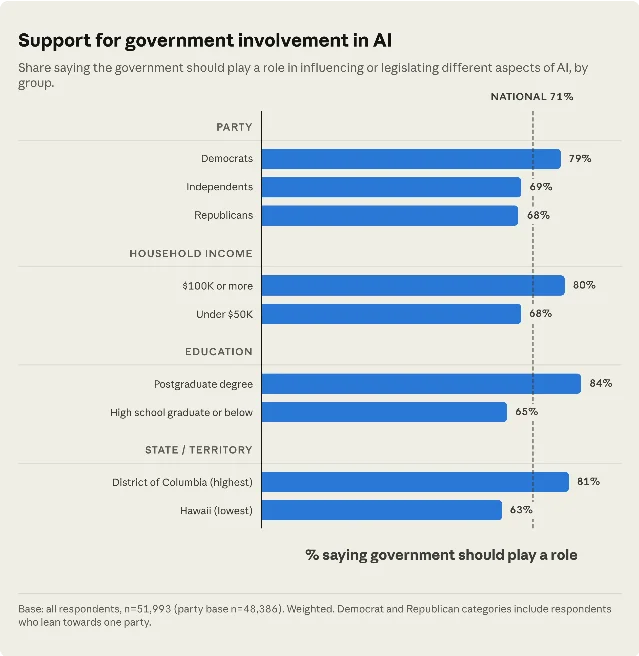
Anthropic's first Public Record survey gives product teams a useful adoption backdrop. In a nationally representative survey of 51,993 Americans fielded in late 2025, 48% ranked curing diseases among their top three hopes for AI, while job loss was the most common fear at 64%. 8 The same survey found that only 15% of Americans trust AI companies to make decisions about how AI is developed and used. 8
This creates a product-design constraint. Users can want AI capability and still distrust AI firms. The winning enterprise and consumer products will probably over-explain control: who can see data, what the model is allowed to do, how errors are caught, and how a human can reverse an action.
What to do before next Monday
Founders should pressure-test three plans this week.
First, review model dependency. If a provider recall, export restriction, retention-policy change, or regional rollout shift would break your product, document the fallback path now.
Second, inspect agent permissions. Any agent that can read customer data, write to production systems, spend money, send messages, or modify records should have a separate identity, scoped permissions, logs, and revocation.
Third, translate reliability claims into evidence. If your product says it is safe, compliant, verified, or enterprise-ready, buyers will increasingly expect proof: repeatable evals, versioned test data, domain rules, and human review points.
The week's through-line is control. The market is rewarding teams that make AI more deployable, auditable, and governable, not just more capable.
围绕这条内容继续补充观点或上下文。